Uncovering Sweden’s Hidden Diversity of Braconid Wasps
Project title: The Braconidae of Sweden
Period: 2026-01-01 to 2027-12-31
Funding: SLU Swedish Species Information Centre, The Swedish Taxonomy Initiative (2 975 918 SEK)
Project leader: Dave Karlsson
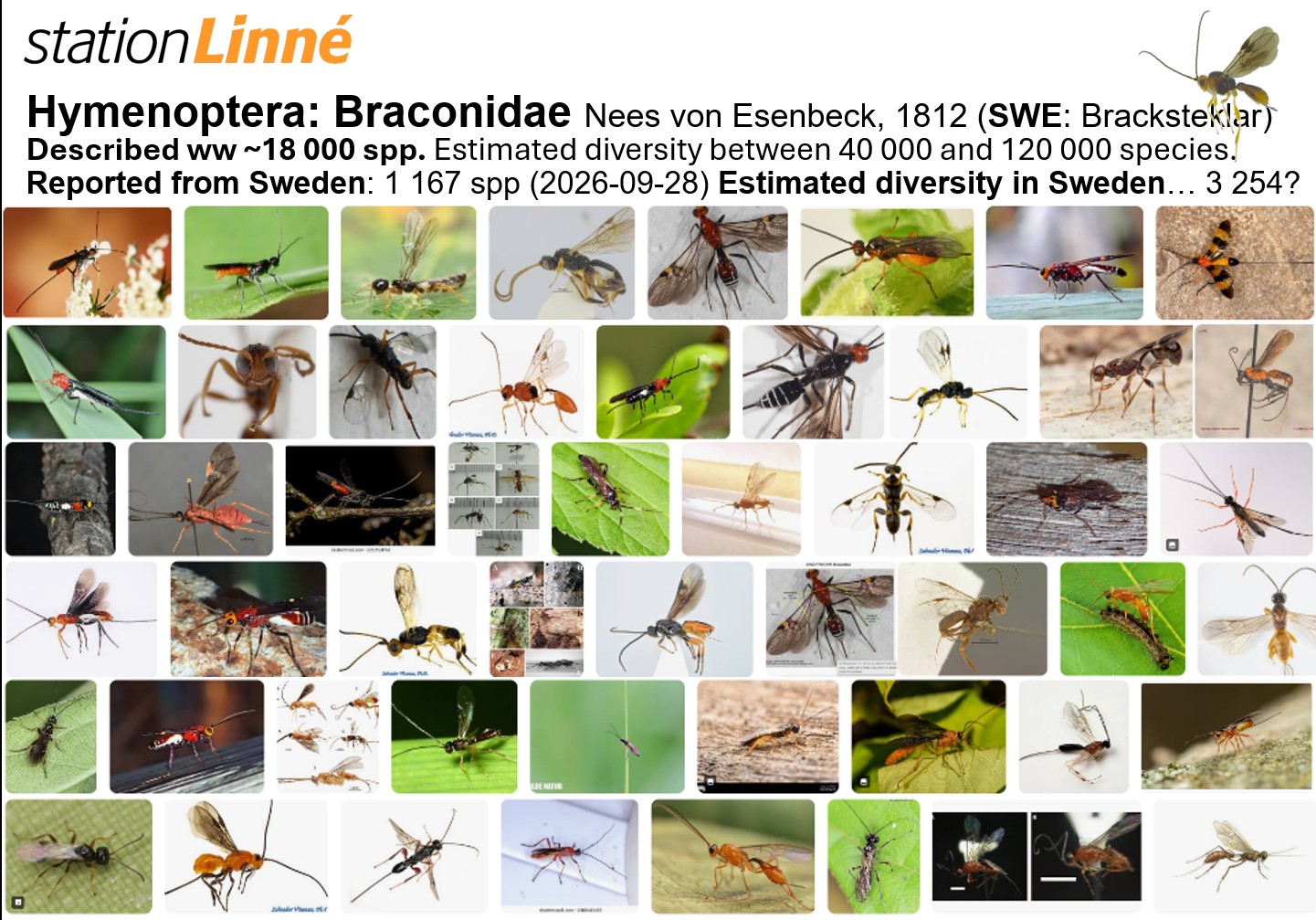
Project overview
Despite a long tradition of entomological research, much of Sweden’s insect diversity remains undocumented. Fewer than 30,000 insect species have been recorded in the country, and preliminary molecular evidence suggests that these may represent only 50–65% of the actual fauna (preliminary, unpublished results from molecular research at Station Linné). Among the groups with particularly large knowledge gaps are the braconid wasps (Hymenoptera: Braconidae) (Karlsson et al. 2020, Ronquist et. al. 2020), a highly diverse family of predominantly parasitoid insects that play important roles in terrestrial ecosystems.
Over recent decades, major Swedish insect inventories have collected millions of specimens, creating an exceptional resource for biodiversity research. However, much of this material remains scientifically unexplored. Large numbers of braconid wasps have already been sorted from these collections, offering an opportunity to investigate a substantial part of Sweden’s hidden insect diversity.
This project aims to analyse approximately 100,000 braconid specimens, combining high-throughput DNA barcoding, Oxford Nanopore sequencing and morphological examination within a framework known as Large-scale Integrative Taxonomy (LIT; Hartop et al. 2022). By integrating molecular and morphological evidence, we aim to establish reliable species boundaries and produce a comprehensive inventory of Swedish braconid diversity, including species that have not yet been formally described.
Rather than focusing primarily on naming individual species, the project seeks to establish a scientifically validated foundation for understanding their diversity, geographical distribution, seasonal occurrence and abundance. This information is essential for ecological research, biodiversity monitoring and conservation.
The project also aims to develop efficient methods that can be applied to other highly diverse and poorly understood insect groups. At the same time, it will provide opportunities for training a new generation of taxonomists in the combination of traditional morphological expertise and modern molecular techniques.
Our broader ambition is to transform decades of insect collecting into reliable, accessible biodiversity knowledge, helping to reveal the true diversity of Sweden’s insect fauna and providing the tools needed to study and protect it.
Scientific background: How much diversity remains undiscovered?
Braconidae is one of the largest families within the order Hymenoptera, surpassed in described species richness only by the closely related Ichneumonidae. Nearly 20,000 braconid species have been formally described worldwide (Bánki et al. 2024), but this number is thought to represent less than half of their actual diversity (Jones et al. 2009).
In Sweden, approximately 1,200 named species have been recorded, although molecular studies suggest that the true number is considerably higher. Previous research, based primarily on morphological evidence, estimated that Sweden supports at least 1,542 braconid species (Ronquist et al. 2020). More recent molecular inventories have indicated even greater diversity.
The Insect Biome Atlas (IBA), a large-scale Swedish biodiversity project based on molecular methods, recovered 1,627 braconid genetic clusters. Of these, 1,282 could not be matched to named species in the Barcode of Life Data System (BOLD), while 636 were not represented in BOLD at all (Miraldo et al. 2025). Although genetic clusters do not necessarily correspond directly to biological species, these findings demonstrate how much diversity remains to be investigated.
Research conducted at Station Linné has already made a substantial contribution to documenting this hidden diversity. DNA barcoding of Swedish braconid specimens has revealed hundreds of distinct genetic clusters, many of which lack reliable species-level identifications. These results highlight both the limitations of existing reference databases and the enormous potential of combining molecular data with traditional morphological expertise.
The challenge is therefore not simply to discover additional species, but to establish reliable species concepts that allow this diversity to be studied, compared and monitored over time.
Methodology: Large-scale Integrative Taxonomy
Traditional taxonomic research, involving detailed morphological examination and formal species descriptions, remains essential for understanding and documenting biodiversity. However, the enormous number of specimens and potentially undescribed species in hyperdiverse insect groups makes it difficult to investigate their diversity at the scale required using conventional methods alone.
This project addresses that challenge by combining large-scale molecular analysis with targeted morphological validation.
Using megabarcoding workflows (Chua et al. 2023) and Oxford Nanopore sequencing, we aim to generate DNA barcode data from approximately 100,000 braconid specimens. These data will provide a molecular framework for identifying genetic diversity and recognising potential species boundaries across the study material.
The molecular results will then be evaluated through Large-scale Integrative Taxonomy (LIT; Hartop et al. 2022), an approach that integrates DNA-based evidence with morphological examination to establish more reliable species delimitations. By prioritising integrative species delimitation rather than attempting to formally describe every species encountered, the project seeks to make a substantial part of this diversity accessible for scientific investigation within a realistic timeframe. The resulting inventory will provide a foundation for subsequent formal taxonomic descriptions, while also enabling broader analyses of biodiversity patterns that would otherwise remain difficult to investigate.
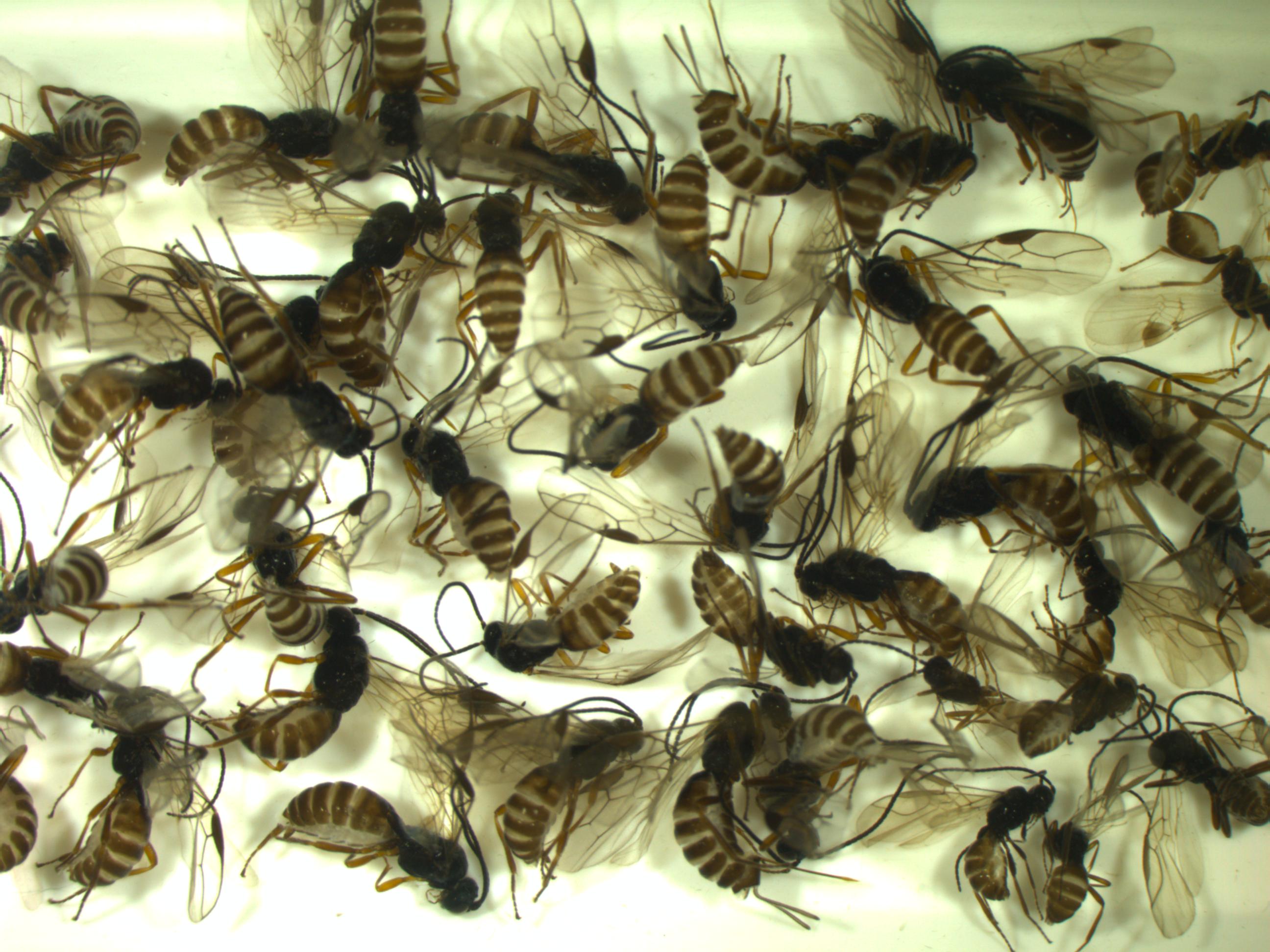
Five similar yet distinct subfamilies of Braconidae (Rhyssalinae, Microgastrinae, Euphorinae, Aphidiinae and Alysiinae) illustrate the challenges involved in identifying these hymenopterans based solely on their morphology.
Project objectives
The project has four principal objectives:
-
Reveal hidden species diversity. Apply megabarcoding (Chua et al. 2023) workflows and Oxford Nanopore sequencing to approximately 100,000 braconid specimens, uncovering previously unrecognised diversity and identifying species that may be new to science.
-
Establish reliable species boundaries. Implement Large-scale Integrative Taxonomy (LIT; Hartop et al. 2022) to combine molecular and morphological evidence, producing a robust and scientifically validated inventory of Swedish braconid species.
-
Advance our understanding of Swedish insect biodiversity. Investigate patterns of species diversity, geographical distribution, seasonal occurrence and abundance, providing essential baseline information for ecological research, biodiversity monitoring and conservation.
-
Develop expertise and methodological capacity. Establish a dynamic training platform for the next generation of taxonomists, offering practical experience at the intersection of classical taxonomy, molecular biology, bioinformatics and biodiversity science.
Broader significance and long-term ambitions
A fundamental challenge in biodiversity science is the large discrepancy between the number of species that exist and those that have been formally described or can be reliably identified. This knowledge gap is particularly pronounced among small, species-rich insect groups, despite their ecological importance.
The project seeks to demonstrate how modern molecular techniques, combined with morphological expertise, can help overcome this challenge. By developing and applying an efficient, scalable framework for species-level assessment, it aims to establish an approach that can also be adapted to other hyperdiverse and poorly understood organism groups.
The scientific value of the project extends beyond the discovery of previously unrecognised species. A validated inventory will make it possible to investigate ecological and geographical patterns across an entire species-rich insect family, creating opportunities for research that are currently constrained by insufficient taxonomic knowledge.
Equally important is the development of taxonomic expertise. By integrating traditional identification skills with emerging molecular and analytical methods, the project aims to strengthen the capacity for biodiversity research and contribute to the training of future specialists.
An equally important ambition is to establish a dynamic training platform for the next generation of taxonomists. By actively involving students and early-career researchers in the project, we aim to provide hands-on experience in an integrative approach that combines traditional morphological taxonomy with modern molecular techniques, bioinformatics and biodiversity analysis. This will not only strengthen individual expertise but also contribute to building and maintaining the taxonomic capacity needed to address the growing challenges of biodiversity research, monitoring and conservation. In this way, the project seeks to create a lasting legacy that extends well beyond its immediate scientific results.
Ultimately, the ambition is to transform the extensive insect collections accumulated through Swedish biodiversity inventories into a lasting scientific resource — one that supports future taxonomic research, improves our understanding of insect biodiversity and contributes to more effective biodiversity monitoring and conservation.
Selected references
-
Bánki O, Roskov Y, Döring M, Ower G, Hernández Robles D R, Plata Corredor C A, Stjernegaard Jeppesen T, Örn A, Vandepitte L, Hobern D, Schalk P, DeWalt R E, Ma K, Miller J, Orrell T, Aalbu R, Abbott J, Adlard R, Aedo C, et al. (2024) Catalogue of Life Checklist (Version 2024-04-26). Catalogue of Life.
-
Chua P Y, Bourlat S J, Ferguson C, Korlevic P, Zhao L, Ekrem T, et al. (2023) Future of DNA based insect monitoring. Trends in Genetics, July 2023, Vol. 39, No. 7. DOI: https://doi.org/10.1016/j.tig.2023.02.012
-
Hartop E, Srivathsan A, Ronquist F, Meier R (2022) Towards Large-Scale Integrative Taxonomy (LIT): Resolving the Data Conundrum for Dark Taxa, Systematic Biology, Volume 71, Issue 6, November 2022, Pages 1404–1422, https://doi.org/10.1093/sysbio/syac033
-
Jones O R, Purvis A, Baumgart E, Quicke L J D (2009) Using taxonomic revision data to estimate the geographic and taxonomic distribution of undescribed species richness in the Braconidae (Hymenoptera: Ichneumonoidea). Insect Conservation and Diversity, 2(3), 204– 212. https://doi.org/10.1111/j.1752- 4598.2009.00057.x
-
Karlsson D, Hartop E, Forshage M, Jaschhof M and Ronquist F (2020a) The Swedish Malaise Trap Project: a 15 year retrospective on a countrywide insect inventory. Biodiversity Data Journal 8: e47255. https://doi.org/10.3897/BDJ.8.e47255.
-
Miraldo, A., Sundh, J., Iwaszkiewicz-Eggebrecht, E. et al. Data of the Insect Biome Atlas: a metabarcoding survey of the terrestrial arthropods of Sweden and Madagascar. Sci Data 12, 835 (2025). https://doi.org/10.1038/s41597-025-05151-0
-
Ronquist F, Forshage M, Häggqvist S, Karlsson D, Hovmöller R, Bergsten J, Holston K, Britton T, Abenius J, Andersson B, et al. (2020) Completing Linnaeus’s inventory of the Swedish insect fauna: Only 5,000 species left? PLoS ONE, 15(3): e0228561.